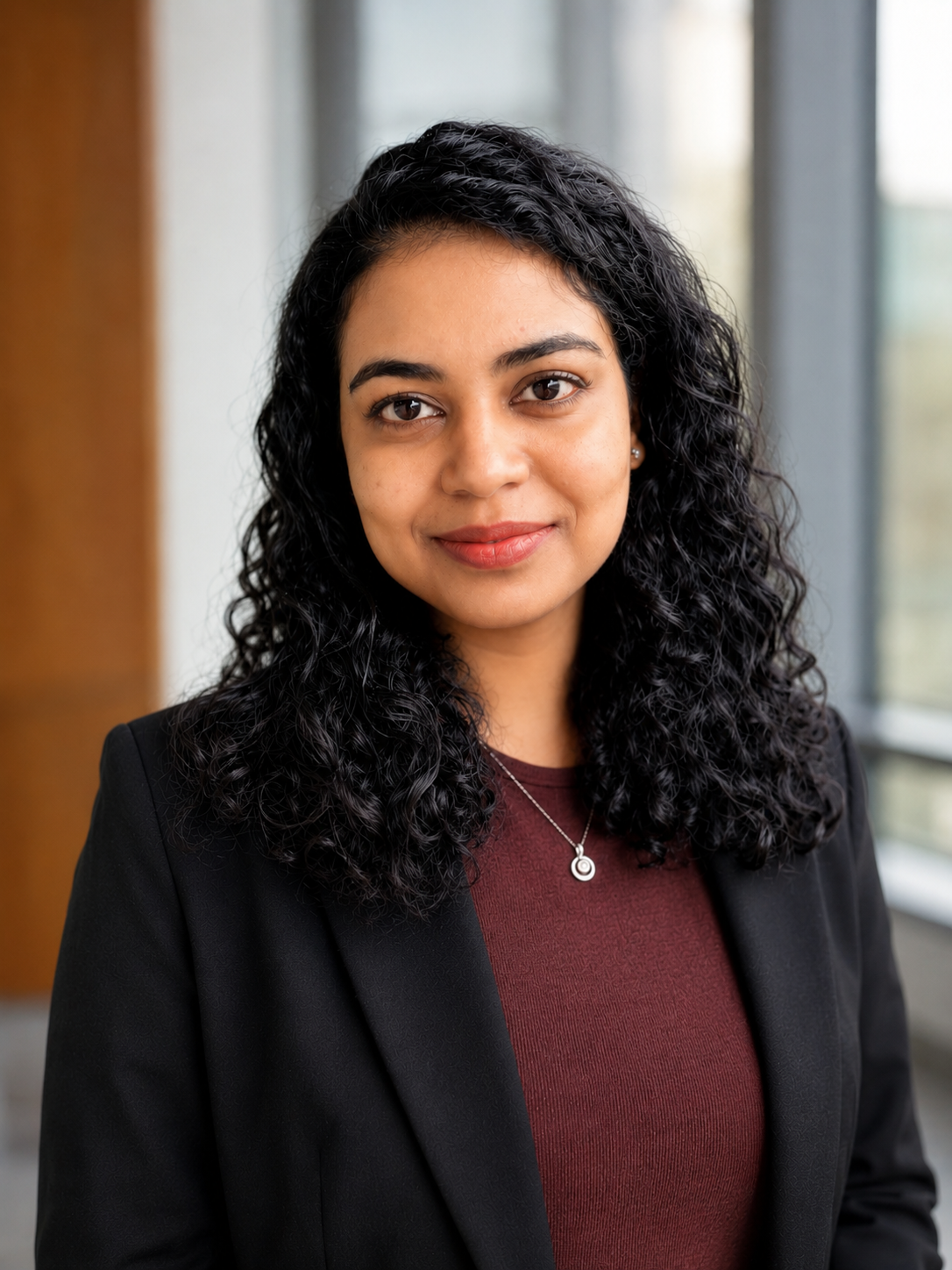
Sandhya Saisubramanian is an Assistant Professor in the School of Electrical Engineering and Computer Science (EECS) at Oregon State University, where she leads the Intelligent and Reliable Autonomous Systems (IRAS) research group. She is also an affiliate member of the Collaborative Robotics and Intelligent Systems (CoRIS) Institute at Oregon State University. Sandhya earned her Ph.D. in Computer Science from the University of Massachusetts Amherst, where she was advised by Shlomo Zilberstein.
Her research interests are in designing AI systems that are safe, reliable, and unbiased. Her current research focus is on developing techniques for reliable decision-making in autonomous systems that operate in fully and partially observable environments. Much of her group’s current research is motivated by decision-making problems in agriculture and robotics. Her research has been recognized with the NSF CAREER award, Outstanding Paper Award at RLC 2025, and IJCAI 2020 Distinguished Paper Award. She is also a recipient of OSU College of Engineering Engelbrecht Early Career Award (2026) and Outstanding Program Committee Member Award at ICAPS 2022. Sandhya served as a Program Co-Chair for the International Conference on Automated Planning and Scheduling (ICAPS), 2026.
Contact: sandhya.sai AT oregonstate.eduOffice: 3005 Kelley Engineering CenterNEW IRAS Opening 1: Our group is looking to recruit 1–2 doctoral students for the 2027–2028 academic year. Preference will be given to those with a strong math background and robotics experience. If you are driven and ambitious and have the required technical background, send me an email with your CV and transcripts.
NEW IRAS Opening 2: Our group is looking to recruit one undergrad (senior) or MS student with experience in robotics or AI/ML and a strong math background.
There are no current openings for high school students or remote internships.
Recent News
Fall 2026:
Congratulations to William Solow on being invited as a student speaker for WSU Plant Science Symposium on the theme of “Growing Intelligence: Where Plant Sciences Meet Artificial Intelligence”!
Honored to receive the OSU Engelbrecht Early Career Award for 2026-2027!
Summer 2026:
Congratulations to Alina Hyk on passing her Honors thesis defense!
Our paper “Multi-Robot Coordination for Planning under Context Uncertainty” has been accepted to IROS 2026!
Spring 2026:
Congratulations to Alina Hyk on being selected as the student speaker at the President’s Commencement Dinner!
Our paper “Beyond Site-Specific Models: Learning Generalizable Cold Hardiness Predictions via Multi-Task and Transfer Learning” has been accepted to the IJCAI Workshop on “AI Systems for the Environment”!
Honored to receive NSF CAREER award!
Our paper on hybrid modeling for crop prediction tasks using multi-task learning has been accepted to IJCAI 2026!
Winter 2026:
Our grape phenology prediction model has been deployed on AgWeatherNet! This model is now available to over 26000 growers to guide their vineyard management!
IRAS group member Alina Hyk recognized with OSU Honors College Joe Hendricks Scholarship for Academic Excellence! Congratulations, Alina!
Our paper on learning transferable latent user preferences accepted to the ICLR Workshop on “From Human Cognition to AI Reasoning: Models, Methods, and Applications”!
Our paper on reward learning from diverse forms of human feedback has been published on Frontiers in AI and Robotics!